There is a particular kind of Arizona home that most people never think to look for: the one that comes with a resort attached. Own the residence outright — not a timeshare, not fractional — and the spa, the dining, the pools, the golf, sometimes even room service, are a short walk from your door. It is lock-and-leave luxury with a five-star resort as your amenity base, and Arizona has been quietly building it for seventy years.
This is a guide to that world — the resort residences of Scottsdale and Paradise Valley, old and new, and the life they’re built around.
Read the Resort Residences guide ↓




The Arizona Resort Residences Guide
Own the home, borrow the resort
The idea is simple and, once you’ve seen it, hard to give up. You buy a home — a villa, a residence, a condominium — in whole ownership, with a deed and all the permanence that implies. But the home sits within, or beside, one of Arizona’s landmark resorts, and that changes everything about how you live in it. The maintenance is handled. The travel is effortless: lock the door, leave for months, come back to find nothing to do but unpack. And the amenities that would cost a fortune to build and staff at a private estate — the spa, the restaurants, the pools, the fitness, the golf, the concierge — are simply there, a few steps away, run by people whose entire business is hospitality. For a certain buyer, particularly one trading a large estate for something lighter, it is the most rational luxury in the Valley.
The heritage resorts
Arizona has been doing this longer than most people realize. Colonia Miramonte may be the most charming example: in the mid-1960s, developers built a gated enclave of homes on the very site where the legendary Camelback Inn once kept its horse stables. The name means “colony with a mountain view,” and today its residents can walk to the Camelback Inn — now a JW Marriott five-star resort — for dinner and the spa, or simply have the resort’s room service delivered to their own kitchen. Mountain Shadows reaches back further still, with roots in the original 1950s resort of the same name; reborn as a contemporary community of mid-century-modern residences and villas arranged around the resort pool, it looks out at Mummy and Camelback and offers its owners the option of placing a home in the hotel rental pool. These are not new ideas dressed up — they are the origins of the form.
The modern villas and residences
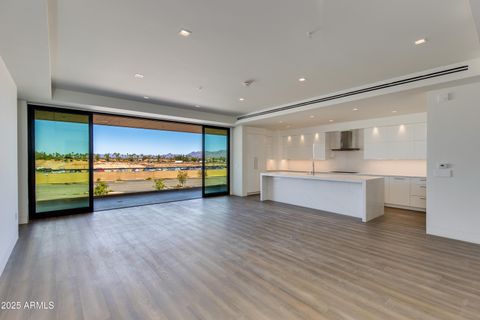
The contemporary wave is where the money and the architecture have gone lately. Montelucia Villas at La Posada, in the foothills of Camelback, is one of the most exclusive lock-and-leave communities in the state — just 34 whole-ownership Spanish-Andalusian villas of 3,800 to 4,700 square feet, with courtyards, elevators, and butler’s kitchens, and the Montelucia resort’s spa and dining at the doorstep. Ascent at The Phoenician, gated against Camelback Mountain and overlooking the Phoenician golf course, brought a collection of villas and low-density residences — including the architecturally significant Summit by Olson Kundig — with a private Mountain Club and access to the Phoenician’s amenities. The Residences at the Ritz-Carlton, within the Palmeraie in Paradise Valley, offer single-level villas with full Ritz service. And ICON at Silverleaf brings the same idea into the guard-gated Silverleaf club world of north Scottsdale. A little different in character is Hilton Casitas, a gated enclave of 29 single-level Ralph Haver-designed patio homes attached to the Hilton Scottsdale Resort & Villas, with full resort privileges — pool, spa, fitness, steakhouse, room service — and, unusually, no rental restrictions, which sets it apart from the lock-and-leave-only communities. Together these span roughly two to ten million dollars, and every one of them is built on the same promise the heritage communities pioneered.
Who buys a resort residence
The buyer here is almost always someone who has done the big house already. They want the space and the finish of a significant home, but not the acre of landscaping, the pool service, the staff, and the worry of leaving it empty for the summer. A resort residence gives them the home without the burden and the resort without the room rate — and for the buyer splitting time between the Valley and somewhere cooler, the lock-and-leave freedom is the entire point. A handful of these communities go a step further and permit short-term rental, which turns a second home into an asset that can earn its keep when you’re away — a genuinely different calculation for the right buyer. It is luxury measured in ease rather than square footage.
Buying and selling a resort residence
This is a specialized corner of the market, and it doesn’t price like a standard home. Value turns on things a normal comp misses: which resort, what level of amenity access conveys, whether short-term rental is permitted and what it yields, and the ownership structure itself — some communities are fee-simple while others, like Hilton Casitas, sit on leased land with a monthly lease offset by unusually low property taxes, a trade-off that materially affects financing and price. A villa at Montelucia and a patio home at Hilton Casitas are both resort residences, but they are not the same product and shouldn’t be priced as if they were.
Marta has sold in this world — including at Montelucia — and works within Russ Lyon Sotheby’s International Realty, which is active across these communities and carries the global Sotheby’s network that a resort-attached luxury property is built to reach. Whether you’re trading an estate for something lighter or looking for the right villa beside the right resort, that’s worth a conversation.