Paradise Valley is not a neighborhood. It is a town — sixteen square miles of it, incorporated in 1961 by residents who wanted one thing above all: to stop it becoming anywhere else. No commercial strips. No office parks. A one-acre minimum on nearly every lot, and, in most of it, no sidewalks and no streetlights at all. What was preserved was the desert, the mountains, and the quiet.
The result is the most valuable address in Arizona and, in some ways, the least showy about it. Camelback Mountain on one side, Mummy Mountain in the middle, estates set so far back from the road you rarely see them. Below are the homes currently for sale — and beneath them, a closer look at the town, its resorts, its two great dining rooms, and what living here actually looks like.
Read the Paradise Valley guide ↓



A Town Built to Stay a Town
Paradise Valley exists because of a decision. By the late 1950s, Phoenix and Scottsdale were both expanding toward the ranch land between them, and annexation by one or the other looked inevitable. In 1961 the residents incorporated instead — not to build a town, but to prevent one. The charter has held the line ever since: no commercial corridors, no industry, a one-acre minimum lot across nearly the whole map, and a resort-and-residence model that funds the town without a primary property tax.
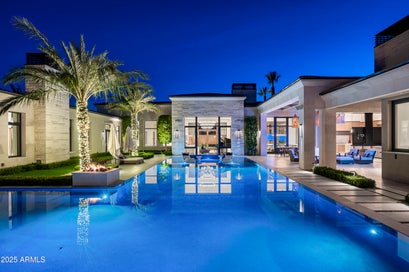
What that buys is space. Estates sit deep behind walls and desert landscaping, streets bend rather than grid, and much of the town has neither sidewalk nor streetlight by design. Drive Lincoln or Tatum at dusk and you can be a hundred feet from a fifteen-million-dollar house and never know it. That restraint is the product. It is also, for the right buyer, the entire point.
Camelback & Mummy Mountain
Two mountains define the town, and between them they set every price in it. Camelback rises on the western edge — the most recognisable landform in the Valley, and the reason the finest streets here bend the way they do. Mummy Mountain sits in the middle, a private ridge with homes climbing its flanks and views back across the whole basin. Elevation is currency in Paradise Valley: the higher the pad, the longer the view, and the more the land is worth before a single wall goes up.
The mountains are also why the town looks the way it does. Hillside building here is governed tightly — grading limits, height restrictions, colour and reflectivity rules — so the estates read as part of the mountain rather than sitting on top of it. It is slow, expensive land to build on. It is also irreplaceable.
The Resorts
The trade Paradise Valley made at incorporation was resorts instead of retail, and it is the reason the town runs without a primary property tax. It also gave residents something unusual: world-class hospitality inside a town of homes. Sanctuary sits high on Camelback’s north slope. The JW Marriott Camelback Inn has been here since 1936. Mountain Shadows was rebuilt as a modern icon with a short course that residents actually play. The Hermosa Inn, tucked into a residential street, is the smallest and the most beloved.
Practically, it means dinner, a spa afternoon, or somewhere to put visiting family is five minutes from the gate — without a commercial district ever appearing in the view from your patio.
Dining & Everyday Life
Paradise Valley doesn’t do restaurant rows. It has two great rooms instead, both tucked into residential streets, both older than the town itself. LON’s at the Hermosa Inn serves dinner inside the adobe studio that cowboy artist Lon Megargee built by hand in 1935 — no blueprints, mine-salvage beams, his paintings still on the walls. El Chorro began life in 1934 as a one-room schoolhouse and became a watering hole three years later, when Camelback Inn guests walked a dirt path across the desert for a drink the inn wouldn’t serve them. The sticky buns are unchanged.
Both are worth understanding properly before you book: the full story of the two tables — and how to do them right — is in The Edit.
For everything else, the town’s geography works in your favour. Old Town Scottsdale, Biltmore, and Arcadia are each roughly ten to fifteen minutes out, which is where the groceries, the boutiques, and the rest of the restaurants live. Paradise Valley keeps none of it — and residents drive to all of it happily, because the alternative is a commercial strip at the end of the street.
Getting Around
Central is the quiet advantage here. Phoenix Sky Harbor is about twenty minutes away — closer than almost any comparable luxury address in the country. Scottsdale Airport, the Valley’s private-aviation hub, is roughly fifteen. The 51 and the 101 bracket the town without crossing it. For a place that feels this removed, almost nothing is far.
The Neighborhoods of Paradise Valley
The town is one municipality but a dozen different markets, and knowing which one you’re in matters more here than almost anywhere in the Valley.
- Camelback corridor — the hillside and foothill streets closest to the mountain. The most dramatic land, the tightest hillside rules, and the top of the market.
- Mummy Mountain — elevation and long views from the centre of town, with the privacy that comes from being surrounded on all sides by Paradise Valley itself.
- The guard-gated enclaves — Clearwater Hills, Camelback Country Club Estates and their peers, for buyers who want a gate on top of a town that already feels gated.
- The flats — the level, mature, deeply landscaped acre lots that make up much of the town’s middle. Less drama, more lawn, and often the better family house.
Architecture & the Land
There is no single Paradise Valley style, and that is deliberate. Because the town was built one custom home at a time across sixty-five years, a 1960s Ralph Haver-era ranch can sit two doors from a glass-and-steel new build and neither looks out of place. What holds it together isn’t a design code but the land itself: one-acre minimums, low profiles, desert planting, and the two mountains that every street ultimately answers to.
The one thing the town does insist on is restraint. Building here means working through a design review process that cares a great deal about height, reflectivity, and what your roofline does to someone else’s view of the mountain. It is slower than building in Scottsdale. It is also why the town still looks like itself.
Discretion
Paradise Valley has a long, well-documented history of famous residents — and a longer history of not talking about them. That isn’t an accident of culture; it’s what the zoning was for. Acre lots, walls, curving streets, and no reason for anyone without a purpose to be on your road. People who could live anywhere choose here precisely because the town is organised, structurally, around leaving them alone.
It’s a useful thing to understand as a buyer. The premium you pay in Paradise Valley isn’t for finishes or square footage — you can buy those anywhere in the Valley. It’s for the distance between you and everyone else, and for a town charter that has protected it for sixty-five years.
The Paradise Valley Market
Paradise Valley spans a wider range than its reputation suggests. The flats and the smaller acre lots open the town at a level that surprises people; the custom estates through the mid-market are the heart of it; and the Camelback hillside holds the highest sales in the state. Land still trades here too — the last unbuilt pads are among the most valuable dirt in Arizona.
What doesn’t vary is the scarcity. Sixteen square miles, one-acre minimums, and a town that decided in 1961 never to make more of itself. Whether you’re exploring Paradise Valley for the first time or quietly preparing to make a move, a conversation about the right street, the right elevation, and the right timing is where it begins.