The south slope of Camelback is the Valley’s most literal luxury: homes carved into rock more than a billion years old, where cutting a driveway can mean years of blasting and no two lots are alike because the mountain won’t allow it. It is the highest, hardest, and most coveted residential ground in Phoenix — and nothing about it is interchangeable.
Marta has sold across it — on Red Rock, Grandview, Valle Vista, and Rockridge, the streets that climb the mountain’s southern face. On terrain this singular, an agent who has actually closed here, more than once, is the difference between a price that reads the parcel and one that guesses at it.


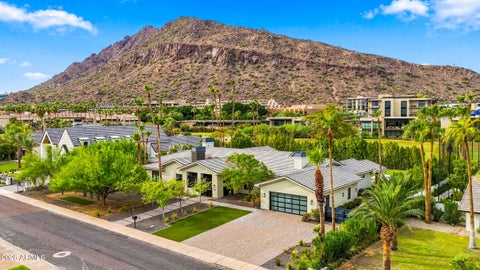


The South Slope Guide
One face of the mountain
This guide covers a single face: the south slope of Camelback, from Camelback Road up to the summit ridge, on the Phoenix side. It is a different animal from the flats of Arcadia below it, and from Paradise Valley over the ridge to the north. Here the ground itself is the constraint — the upper mountain is Precambrian granite well over a billion years old, and building on it has always meant working with rock that does not yield. That is the whole character of the place. Every home is a negotiation with the mountain, and the mountain sets the terms.
The Castle sets the standard
Nothing explains the south slope faster than the house at the top of it. Copenhaver Castle, at 5050 E. Red Rock Road, is the highest home in Phoenix — roughly 450 feet above Camelback Road, on a lot the sellers believed was unbuildable when a Phoenix orthodontist named Mort Copenhaver bought it in 1967 for four thousand dollars. It took him three years just to blast the driveway into the cliff, and twelve more to finish the fortress, its walls built from stone pulled out of the mountainside itself. It is visible from 44th Street, and it is the archetype for everything below it: one person, against the rock, refusing to lose.
The streets
Marta’s track record climbs the same face — Red Rock, Grandview, Valle Vista, Rockridge. Each street ascends differently, and each carries its own mix of original hillside homes and modern rebuilds. The sale on Red Rock is the one worth pausing on: it stood among the highest occupied homes on the mountain, bested — fittingly — only by the Castle above it on the same street. On a mountain where elevation, exposure, and the view corridor are the whole game, being second only to the most famous house in Phoenix is not a small thing.
What the mountain does to people
The Castle is not the only monument to obsession up here. Somewhere on the slope is a home whose owner spent three years jackhammering into that same ancient rock — not, this time, to build a castle, but to carve out a garage. Opinions in the neighborhood are divided, to put it gently. But it is the Castle’s story told again in a minor key, and it is exactly what the mountain does to people. This ground rewards the stubborn, and it always has.
A storied base
The foot of the south slope has been glamorous for a century. Royal Palms — on the Phoenix side at 5200 E. Camelback, built in 1929 as a winter estate by a nephew of J.P. Morgan — is a Spanish Colonial landmark where guests once gathered in the Orange Tree room to hear the Sinatra-era acts of the day. At the mountain’s eastern foot, the Phoenician anchors the Scottsdale side, so the two grand resorts bracket the same Phoenix–Scottsdale seam that runs through Arcadia below. Add the Maytag estate and a century’s worth of notable — and occasionally notorious — Phoenix names, and the slope carries more history per acre than anywhere else on the mountain.
Selling on the slope
This is the hardest terrain in the Valley to price, and the easiest to get wrong. On the flats, a comp a few doors down means something. On the mountain it can be worthless: two homes a hundred feet apart can differ by elevation, buildable area, view corridor, solar orientation, and the sheer difficulty of getting to the front door — and those differences are worth a fortune or nothing depending on the buyer. Automated valuations are effectively blind up here.
What a home on the south slope is worth comes down to the specific parcel and the specific view, priced against the handful of mountain homes it genuinely competes with rather than whatever sold nearby. That is a read you get from having actually transacted on this face of the mountain — and it is worth a conversation.