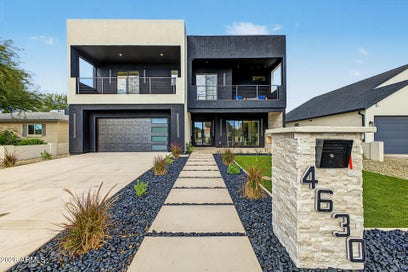
Arcadia is the neighborhood that invented the move Paradise Valley later copied. Long before the Valley’s teardown boom, buyers here were quietly doing the math: a 3,000-square-foot ranch from the 1950s, sitting on a flood-irrigated citrus lot, is not really a house — it’s land with a teardown on it. What rises in its place is 8,000 square feet of farmhouse, or craftsman, or transitional Santa Barbara. That churn has been running, parcel by parcel, for two decades.
Which is why Arcadia rewards a buyer who reads the block, not the average. It is one of the few neighborhoods in the Valley where lot-by-lot history matters more than the subdivision — and where the city line running through it quietly changes what an address is worth.




The Arcadia Guide
Water is the whole story
Arcadia was citrus first. To move water from the Arizona Canal to the groves, the Arcadia Water Company was founded in 1919; by 1924 it had built pumping stations and fifteen miles of concrete pipe. Citrus was farmed here into the mid-1950s, and then the groves gave way to ranch homes on unusually large lots — but the irrigation stayed.
That is why an Arcadia lawn looks like nothing else in Phoenix. The flood irrigation that once fed orange and grapefruit trees still runs, and mature citrus survives in yards all over the neighborhood as a living reminder of what the land used to be. It is also, in practical terms, why the lots are green and deep in a desert city — a piece of century-old infrastructure that a buyer is, whether they realize it or not, buying into.
The Phoenix–Scottsdale line
Here is the thing that trips up nearly every buyer, and the single best reason to have an agent who actually knows Arcadia: the neighborhood is split between two cities, and the boundaries don’t line up.
Running east, the Phoenix 85018 ZIP gives way to the Scottsdale 85251 ZIP around 60th Street — so the eastern slice of Arcadia, roughly 60th to 68th, carries a Scottsdale address on a home that is, by every other measure, Arcadia. For a certain buyer, that is the entire search: Arcadia character, Scottsdale address.
But the address line, the city line, and the school line are three different maps. Much of Arcadia — including homes with a Phoenix ZIP — sits inside the Scottsdale Unified School District. So a buyer chasing “Scottsdale” might be chasing the address, the schools, or the municipality, and those are not the same boundary. Untangling which one a buyer actually wants, and pricing a home against the right one, is knowledge a portal cannot supply.
Exeter, and the gas that never went off
If Arcadia has a most-premier street, it is Exeter Boulevard — deep lots, architectural custom homes, the kind of block where generational owners sit next to fresh eight-figure rebuilds. A small detail tells you how far back the neighborhood’s roots run: a few homes on Exeter still light their coach lamps with real gas. Not many — a handful, if you know to look — but it is the same theme as the citrus and the canal. Arcadia is a place where old infrastructure was kept on purpose, because it is part of what the address means.
The food corner that anchors it
Arcadia’s center of gravity is the corner of 40th Street and Campbell, where La Grande Orange — the gourmet grocery, café, and pizzeria that opened in 2001 — turned a neighborhood market into a destination. Across the street, its burger spin-off, Ingo’s Tasty Food, occupies a cylinder of steel and brick designed by the Phoenix architect Will Bruder. (The name comes from a partner’s childhood violin teacher; the more honest reading is “in goes tasty food.”) It is the rare neighborhood where the dining is genuinely walkable and genuinely good, and it is a real part of why buyers pay to be here.
Selling in Arcadia
Arcadia is the hardest kind of neighborhood to price with a spreadsheet, and the easiest to price wrong. On a single street you will find an original 1950s ranch, a tasteful remodel, and a brand-new 8,000-square-foot build — three completely different products the automated models treat as one. Add the Phoenix–Scottsdale address premium on the eastern end and the view premium on the northern slope, and the “neighborhood average” becomes actively misleading.
What a home here is worth depends on the specific parcel: which side of the city line, how deep the lot, whether the irrigation runs, what the Camelback view looks like from the second floor. Pricing it against the handful of homes it genuinely competes with — not the block average an appraiser or a portal reaches for — is the whole job, and in Arcadia the gap between those two numbers is measured in the high six figures. That is worth a conversation.